
Introduction
Content Sliding website is one of the famous and creative design techniques for portfolio website. One thing, please make sure you put the menu on every single page to avoid confusion/dizziness.
- You should put the navigation menu in every single page
- Or, fix the position of the menu
- Let your visitors know exactly what section they're reading, like highlight the selected menu item and have a clear title
In this tutorial, we will learn to scroll your web content vertically, horizontally and plus diagonally! Don't worry, we won't rely on javascript too much, we will use css/html for the layout and javascript only do the scrolling. And hey, it will still work even if your browser doesn't support javascript.
And, thanks to Ariel Flesler, his scrollTo plugin is simply amazing!
1. HTML
Depend on which direction you want to scroll your website, each of them have slightly different layout. For the horizontal and vertical, they use the same layout, whereas for diagonal, you have to add extra div to create the "diagonal". It sounds like a dirty trick, but hey, it works! :)
I put <a name="name"></a>, just in case some of the browsers out there don't support javascript.
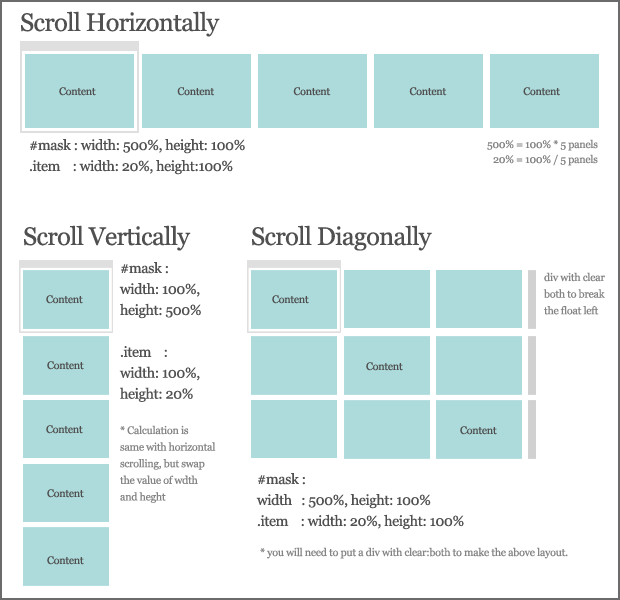
Scroll Horizontally & Vertically
<div id="wrapper">
	<div id="mask">

		<div id="item1" class="item">
			<a name="item1"></a>
			<div class="content">item1
				<a href="#item1" class="panel">1</a> |
				<a href="#item2" class="panel">2</a> |
				<a href="#item3" class="panel">3</a> |
				<a href="#item4" class="panel">4</a> |
				<a href="#item5" class="panel">5</a>
			</div>
		</div>

		<div id="item2" class="item">
			<a name="item2"></a>
			<div class="content">item2 <a href="#item1" class="panel">back</a></div>
		</div>

		<div id="item3" class="item">
			<a name="item3"></a>
			<div class="content">item3 <a href="#item1" class="panel">back</a></div>
		</div>

		<div id="item4" class="item">
			<a name="item4"></a>
			<div class="content">item4 <a href="#item1" class="panel">back</a></div>
		</div>

		<div id="item5" class="item">
			<a name="item5"></a>
			<div class="content">item5 <a href="#item1" class="panel">back</a></div>
		</div>

	</div>
</div>

<div id="wrapper">
	<div id="mask">

		<!-- first row -->

		<div id="item1" class="item">
			<a name="item1"></a>
			<div class="content">item1
				<a href="#item1" class="panel">1</a> |
				<a href="#item2" class="panel">2</a> |
				<a href="#item3" class="panel">3</a>
			</div>
		</div>

		<div class="item"></div>
		<div class="item"></div>
		<div class="clear"></div>

		<!-- second row -->

		<div class="item"></div>

		<div id="item2" class="item">
			<a name="item2"></a>
			<div class="content">item2 <a href="#item1" class="panel">back</a></div>
		</div>

		<div class="item"></div>
		<div class="clear"></div>

		<!-- third row -->

		<div class="item"></div>
		<div class="item"></div>

		<div id="item3" class="item">
			<a name="item3"></a>
			<div class="content">item3 <a href="#item1" class="panel">back</a></div>
		</div>

		<div class="clear"></div>

	</div>
</div>
<div id="wrapper">
	<div id="mask">

		<div id="item1" class="item">
			<a name="item1"></a>
			<div class="content">item1
				<a href="#item1" class="panel">1</a> |
				<a href="#item2" class="panel">2</a> |
				<a href="#item3" class="panel">3</a> |
				<a href="#item4" class="panel">4</a> |
				<a href="#item5" class="panel">5</a>
			</div>
		</div>

		<div id="item2" class="item">
			<a name="item2"></a>
			<div class="content">item2 <a href="#item1" class="panel">back</a></div>
		</div>

		<div id="item3" class="item">
			<a name="item3"></a>
			<div class="content">item3 <a href="#item1" class="panel">back</a></div>
		</div>

		<div id="item4" class="item">
			<a name="item4"></a>
			<div class="content">item4 <a href="#item1" class="panel">back</a></div>
		</div>

		<div id="item5" class="item">
			<a name="item5"></a>
			<div class="content">item5 <a href="#item1" class="panel">back</a></div>
		</div>

	</div>
</div>

<div id="wrapper">
	<div id="mask">

		<!-- first row -->

		<div id="item1" class="item">
			<a name="item1"></a>
			<div class="content">item1
				<a href="#item1" class="panel">1</a> |
				<a href="#item2" class="panel">2</a> |
				<a href="#item3" class="panel">3</a>
			</div>
		</div>

		<div class="item"></div>
		<div class="item"></div>
		<div class="clear"></div>

		<!-- second row -->

		<div class="item"></div>

		<div id="item2" class="item">
			<a name="item2"></a>
			<div class="content">item2 <a href="#item1" class="panel">back</a></div>
		</div>

		<div class="item"></div>
		<div class="clear"></div>

		<!-- third row -->

		<div class="item"></div>
		<div class="item"></div>

		<div id="item3" class="item">
			<a name="item3"></a>
			<div class="content">item3 <a href="#item1" class="panel">back</a></div>
		</div>

		<div class="clear"></div>

	</div>
</div>
Scroll Diagonally
<div id="wrapper">
	<div id="mask">

		<div id="item1" class="item">
			<a name="item1"></a>
			<div class="content">item1
				<a href="#item1" class="panel">1</a> |
				<a href="#item2" class="panel">2</a> |
				<a href="#item3" class="panel">3</a> |
				<a href="#item4" class="panel">4</a> |
				<a href="#item5" class="panel">5</a>
			</div>
		</div>

		<div id="item2" class="item">
			<a name="item2"></a>
			<div class="content">item2 <a href="#item1" class="panel">back</a></div>
		</div>

		<div id="item3" class="item">
			<a name="item3"></a>
			<div class="content">item3 <a href="#item1" class="panel">back</a></div>
		</div>

		<div id="item4" class="item">
			<a name="item4"></a>
			<div class="content">item4 <a href="#item1" class="panel">back</a></div>
		</div>

		<div id="item5" class="item">
			<a name="item5"></a>
			<div class="content">item5 <a href="#item1" class="panel">back</a></div>
		</div>

	</div>
</div>

<div id="wrapper">
	<div id="mask">

		<!-- first row -->

		<div id="item1" class="item">
			<a name="item1"></a>
			<div class="content">item1
				<a href="#item1" class="panel">1</a> |
				<a href="#item2" class="panel">2</a> |
				<a href="#item3" class="panel">3</a>
			</div>
		</div>

		<div class="item"></div>
		<div class="item"></div>
		<div class="clear"></div>

		<!-- second row -->

		<div class="item"></div>

		<div id="item2" class="item">
			<a name="item2"></a>
			<div class="content">item2 <a href="#item1" class="panel">back</a></div>
		</div>

		<div class="item"></div>
		<div class="clear"></div>

		<!-- third row -->

		<div class="item"></div>
		<div class="item"></div>

		<div id="item3" class="item">
			<a name="item3"></a>
			<div class="content">item3 <a href="#item1" class="panel">back</a></div>
		</div>

		<div class="clear"></div>

	</div>
</div>
<div id="wrapper">
	<div id="mask">

		<div id="item1" class="item">
			<a name="item1"></a>
			<div class="content">item1
				<a href="#item1" class="panel">1</a> |
				<a href="#item2" class="panel">2</a> |
				<a href="#item3" class="panel">3</a> |
				<a href="#item4" class="panel">4</a> |
				<a href="#item5" class="panel">5</a>
			</div>
		</div>

		<div id="item2" class="item">
			<a name="item2"></a>
			<div class="content">item2 <a href="#item1" class="panel">back</a></div>
		</div>

		<div id="item3" class="item">
			<a name="item3"></a>
			<div class="content">item3 <a href="#item1" class="panel">back</a></div>
		</div>

		<div id="item4" class="item">
			<a name="item4"></a>
			<div class="content">item4 <a href="#item1" class="panel">back</a></div>
		</div>

		<div id="item5" class="item">
			<a name="item5"></a>
			<div class="content">item5 <a href="#item1" class="panel">back</a></div>
		</div>

	</div>
</div>

<div id="wrapper">
	<div id="mask">

		<!-- first row -->

		<div id="item1" class="item">
			<a name="item1"></a>
			<div class="content">item1
				<a href="#item1" class="panel">1</a> |
				<a href="#item2" class="panel">2</a> |
				<a href="#item3" class="panel">3</a>
			</div>
		</div>

		<div class="item"></div>
		<div class="item"></div>
		<div class="clear"></div>

		<!-- second row -->

		<div class="item"></div>

		<div id="item2" class="item">
			<a name="item2"></a>
			<div class="content">item2 <a href="#item1" class="panel">back</a></div>
		</div>

		<div class="item"></div>
		<div class="clear"></div>

		<!-- third row -->

		<div class="item"></div>
		<div class="item"></div>

		<div id="item3" class="item">
			<a name="item3"></a>
			<div class="content">item3 <a href="#item1" class="panel">back</a></div>
		</div>

		<div class="clear"></div>

	</div>
</div>
2. CSS
The CSS is basically almost the same with the tabbed based content slider tutorial. I have illustrated how it works in that tutorial, so you might wanna check that out as well.
Scroll Horizontally & Diagonally
Â
- #mask : height=100%, width = 100% * total of items
- .item : height=100%, width = 100% / total of items
body {
	height:100%;
	width:100%;
	margin:0;padding:0;
}

#wrapper {
	width:100%;
	height:100%;
	position:absolute;
	top:0;left:0;
	background-color:#ccc;
	overflow:hidden;
}

	#mask {
		width:500%;
		height:100%;

		background-color:#eee;
	}

	.item {
		width:20%;
		height:100%;
		float:left;
		background-color:#ddd;
	}


	.content {
		width:400px;
		height:300px;
		top:20%;
		margin:0 auto;
		background-color:#aaa;
		position:relative;
	}

	.selected {
		background:#fff;
		font-weight:700;
	}

	.clear {
		clear:both;
	}
Scroll Vertically
The width and height are opposite from scrolling horizontally. Calculations are:
- #mask : width=100%, height = 100% * total of items
- .item : width=100%, height = 100% / total of items
	#mask {
		width:100%;
		height:500%;
		background-color:#eee;
	}

	.item {
		width:100%;
		height:20%;
		float:left;
		background-color:#ddd;
	}
3. Javascript
So, you must be thinking how complicated the javascript would be. You'll be surprise! its only a line of code to make the scrolling effect. Thanks to jquery.scrollTo Plugin. What we have to do is solve the layout using css/html, and the plugin will do the rest.
$(document).ready(function() {

	//get all link with class panel
	$('a.panel').click(function () {

                //reset and highlight the clicked link
		$('a.panel').removeClass('selected');
		$(this).addClass('selected');

		//grab the current item, to be used in resize function
		current = $(this);

                //scroll it to the destination
		$('#wrapper').scrollTo($(this).attr('href'), 800);

                //cancel the link default behavior
		return false;
	});


	//resize all the items according to the new browser size
	$(window).resize(function () {

		//call the resizePanel function
		resizePanel();
	});

});
This resize function have 2 versions. One for vertical and another for both horizontal and diagonal. The only difference is the mask_height and mask_width.
Verticalfunction resizePanel() {
//get the browser width and height
width = $(window).width();
height = $(window).height();
//get the mask height: height * total of items
mask_height = height * $('.item').length;
//set the dimension
$('#wrapper, .item').css({width: width, height: height});
$('#mask').css({width: width, height: mask_height});
//if the item is displayed incorrectly, set it to the corrent pos
$('#wrapper').scrollTo($('a.selected').attr('href'), 0);
}
Horizontal & Diagonal
function resizePanel() {

	//get the browser width and height
	width = $(window).width();
	height = $(window).height();

	//get the mask width: width * total of items
	mask_width = width * $('.item').length;

	//set the dimension
	$('#wrapper, .item').css({width: width, height: height});
	$('#mask').css({width: mask_width, height: height});

	//if the item is displayed incorrectly, set it to the corrent pos
	$('#wrapper').scrollTo($('a.selected').attr('href'), 0);

}
Conclusion
That's it, simple and easy! I hope you all will enjoy it.
Last but not least, I need your support :) If you like this article, please help me to promote it by adding this post into your bookmark. You can subscribe to my RSS for more jQuery tutorial posts! Or go to my website footer to follow me on twitter, and buy me a drink! Thanks!
Jump to Certain Item on Page Load
This is one of the most popular request. A lot of people want this content slider to display certain item on page load. It's simple, you need to use this:
$(document).ready(function () {

   $('#wrapper').scrollTo('ITEM-ID-HERE', 0);

   ......
   ......
   ......
}
With that line of code, the slider will jump to the item on page load.

Comments will be moderated and
rel="nofollow"will be added to all links. You can wrap your coding with[code][/code]to make use of built-in syntax highlighter.How would I go about increasing the distance between the content divs while still keeping them centered?
Thanks
I find that if I increase the width of .item any larger than 33% the 3x3 grid structure breaks. I was using .content top: 5% to keep it centered which was working pretty well.
So I had .item {width:33%; height:400%;}
.content {width:875px; height: 500px; top:5%; left: -20%;}
But anything larger than this and the divs end up all over the place.
Thanks again!
#wrapper is 100%... which will be the width of the browser,
and then, the mask is 300% of the #wrapper, (3x3.. 3 item in a row, so 100% x 3)..
and the content recommended to be the same width or smaller than .item div.. because .content is a child of .item.. if it's larger than its parent, it will break the grid.
This script is awesome by the way. It works so much more efficiently than the other versions I have tried. Nic work
I applied the script to my site but the scrolling effect doesnt work :(
i have <tr> inside the <div>, will this be a reason?
Soo I just have a little query. How do you actually highlight the menu tab that is selected when it is selected so that when I am on the page I can clearly see which one I am on? Maybe I missed that part.
Thankies
So I created a scroll bar. Now I want the scrollbar to be fixed, because when its scrolling horizontally, the scrollbar scrolls too and it looks a bit untidy. What should I do?
I forgot to clarify that the reason why I'm seeing overlap is because the background images on my divs are transparent, if you set the opacity of your content divs to say .40, and then increased the content width to around 700px, it will be very obvious what the overlap is. If you have a solution to that, that would be really great, but if not, I can still live with it, and either way, thanks for the great tutorial.
how can I start the horizontal slider at item3 for example. I don't wanna start at item1, because I'd like to start at item3 and then jump to left and right.
Is that possible?
Thx!
$('#wrapper').scrollTo('#item3'), 0);
If you resize your window right after the page loads, all of the items divs will move to the left, messing up the position. However, if the page loads and instead of immediately resizing the window you first click on a link to scroll to another page, and then attempt to resize the window, everything will work just fine. In the case of Firefox 4 on my mac and IE9 on windows, which I've tested respectively, resizing right after it loads to the desired starting div actually results in jumping back to the first item div. Sorry for raising so many questions/problems. Thanks for the great tutorial again!
Forgive me for my ignorance but where would this code be inserted?
"Just put this on window load:" is over my head as I'm not at all versed in this. Thanks for you consideration to all who made this possible.
var max = 8; //number of sections
function goToNext() {
var hash = String(document.location.hash);
var newh = Number(hash.replace("#item",""));
(newh > max-1) ? newh = 0 : void(null);
document.location.hash = "#item" + String(newh+1);
}
<a href="#" class="panel" onclick="goToNext(); return false;">link</a>
$('#wrapper').scrollTo($( '#item' + String(newh+1) ), 800);
I am also trying to incorporate prev/next buttons. I can't seem to get it to work. Would you mind writing the complete script with correction so I can see how it looks.
Thanks in advance.
Thanks.
I followed the tutorial and I got some amazing results, my idea is a page that is lying down and changing the section to this effect. My problem comes when the horizontal scroll, items (item1, item2) have different heights. All items remain the same height, resulting in that if an item has a smaller high because the content is less, this item is extended to match the other creating a empty space and meaningless.
My question is whether there is any way to customize items, each with its height but not disable the vertical scroll. I tried to create different types of items but have not obtained results. Any suggestions or help is welcomed and appreciated to infinity.
Thank you very much everybody.
My test file has not changed practically nothing except some parts of css code. In wrapper, I just placed an overflow-y: auto; overflow-x: hidden; to maintain the feeling of sliding horizontal and vertical scroll to perform.
The next change is just the item .content, where I placed a width of 1024px and a height of 4000px, and I removed the top placement 20% to simulate a traditional page with the sliding effect on change section.
The third and final change is to duolicate .content (.content2) to create a little height (2000 px) to simulate a page with less content (in this case, item 5)
Here the files to have a more realistic view. If you visualize the page in the browser (in my case Safari 5.1) when moves to item5 (black) and when you go down a completely empty space is filled to equal in height to the other .content (4000px). My question is if we can solve this problem and that the scroll ends when it should end (in this case, .content to 4000px in .content 2 to 2000px, and so with each if must be different)
Thank you so much
http://www.megaupload.com/?d=RVWC19OG
my apologies if you've already gone into this but I have maybe a silly question...
I have followed this tut and have managed to get it rolling successfully in a manner..
Example..
http://contagiouscreative.co.uk/salomon/test/sfp_blacknav.html
You'll see that when clicking on one to 5 or the 1st to the 5th menu item at the top, things appear to work fine.
When clicking the 6th you can see the funny scrolling caused because the 6th item that I've added is dropping down a line due to a width that im not adjusting somewhere.
It would be great if you could point me in the right direction as this would help me to fully understand whats going on.
Thanks in advance.
#mask : width = 100% * total of items
.item : width = 100% / total of items
menu link:
<a href="#item6" class="panel">6</a>
new item:
<div id="item6" class="item">
<a name="item6"></a>
<div class="content">item6 <a href="#item1" class="panel">back</a></div>
</div>